The Short Side of Kuzumi
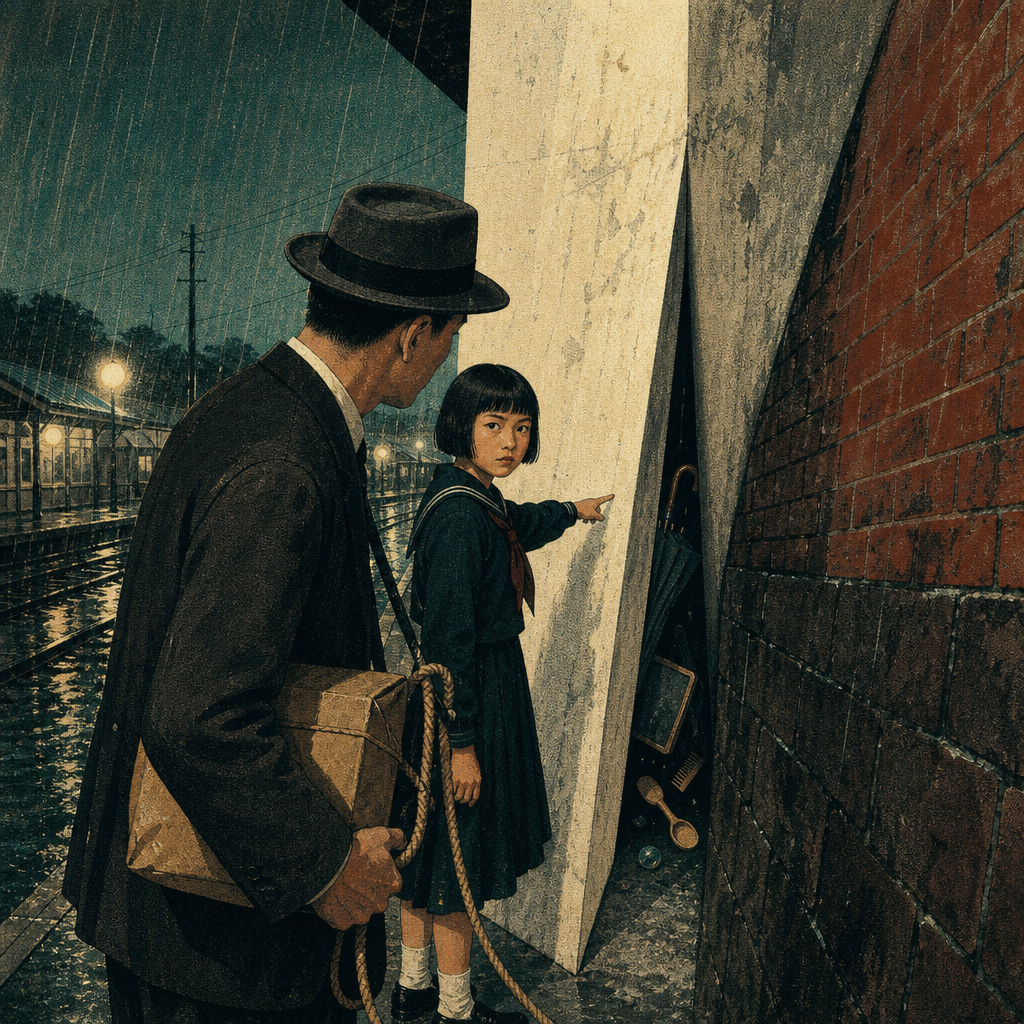
By four o’clock the rain had found every weakness in Kuzumi.
It ran from tiled roofs in ropes, stood in the ruts of the lane, and struck the paper shutters of the lodging house like thrown rice. Sadao Nishikawa had his hat on and his sample case under one arm when Chiyo Enomoto caught him at the gate.
“Nishikawa-san. Please.”
She was barefoot on the wet boards, sleeves pushed up as if she had been washing. Her face had the look of a person who had already searched every room.
“Tetsu has taken something of yours.”
Sadao looked down at his coat.
“My parcel?”
“He was playing postman. He saw you packing it. He said the German gentleman at the station was waiting, and he would deliver it first.”
“Where is he?”
“Mina says he went by the thin side.”
From the doorway, a girl of twelve stared at him with grave annoyance. Mina Enomoto held a rain cape over one arm, her black hair tied back with a red cord.
“He took it from the coal shed,” she said.
“The thin side?”
“ほそいほう.”
“The narrow way?”
“The thin side.” Mina pointed behind the house. “He said the station was nearer that way.”
The parcel contained a replacement governor spring for a German milling machine, packed in oiled paper and a wooden sleeve. Anton Mertens was to inspect it before boarding the six o’clock train for Yokohama. The label said, in black German print, Nicht kippen.
Do not tip.
Sadao had guarded it for three days from trunks, elbows, and porter carts. Yet Chiyo’s face left no room for invoices.
“I’ll find him.”
Behind the house, the coal shed leaned against a plaster boundary wall. Rainwater dripped from its eaves into a black trough. Child-sized sandal prints crossed the mud, reached the wall behind the coal bins, and stopped.
There was no gate. The plaster was green at the base and unbroken from end to end.
Sadao put his palm against it. Cold, wet plaster.
“He came here?”
“Not here. There.”
Mina pointed at the right angle where wall, shed, and coal bin nearly met.
“It is too wide for you,” she said. “You are looking at the wide side.”
Chiyo made a small sound. “Mina.”
“I’ll bring him back.”
Sadao glanced toward the lane. “The station is ten minutes by road.”
“Not if he went thin.”
The rain drummed harder. Somewhere beyond the houses, the station bell struck the quarter-hour.
Sadao set down his sample case. “Show me.”
Mina pulled on her cape. “Do not look for a door. Hold my sleeve, not my hand.”
“Why?”
“If you hold hands, you pull.”
She placed herself sideways in the corner between wall and coal bin, where Sadao would have sworn there was not room for her shoulders. She did not vanish. His attention simply slid away from her, as if rain had passed before his eyes.
“Mina?”
“My sleeve.”
He reached forward and caught wet cotton.
The sensation was not of passing through a wall. It was worse, because it was ordinary in every part except its direction. His left shoulder brushed plaster; his right knee struck brick. He took two cramped steps. Then plaster became rough timber, the coal smell fish crates and railway smoke, and rain struck corrugated iron above him.
He emerged behind a locked warehouse near Kuzumi Station, still clutching Mina’s sleeve.
The warehouse door was chained. Its rear wall backed directly onto the station embankment. Between them lay a strip of mud, a broken handcart, and a drainage ditch swollen to its lip.
The lodging house ought to have been four streets away.
Mina pulled free. “You looked.”
“I tried not to fall.”
“You tried to remember where you were going.”
Sadao looked back. There was no passage: only the warehouse wall, the brick slope of the embankment, and a right-angled niche full of rainwater.
Beyond the warehouse, station lamps had already been lit against the afternoon darkness.
“Come,” he said. “If Tetsu means to deliver it, he may be on the platform.”
Mina did not move. Her head had tilted toward the embankment.
“Tetsu,” she called.
At first there was only rain. Then, faintly, from somewhere below their feet:
“Nee-chan!”
Mina’s face changed.
“There.”
Sadao heard only the rush of water.
They ran around the warehouse to the station yard. Kuzumi Station was a low wooden building with a deep eave and wet banners hanging beside the ticket window. Under the eaves stood a tall European in a dark travelling coat, his hat under one arm. A leather case rested beside him.
Anton Mertens saw Sadao at once.
“Herr Nishikawa. Das Paket?”
Sadao stopped, soaked to the cuffs. “Mertens-san, I am very sorry. There has been an accident. A child has taken it.”
“The parcel is damaged?”
“No. I think not.”
Mertens stared at him.
“He meant to deliver it,” Sadao added.
Mertens said something quick in German, then checked himself. “My train leaves at six. I cannot remain another night in this place.”
“I understand.”
“You understand German contracts too, I hope.”
“Yes.”
“How long?”
“I do not know.”
“That is not a business answer.”
“No.”
From behind the station, Mina called, “He is under the hill.”
The visible mouth of the drainage culvert opened beneath the embankment fifty yards away. Brown water thundered through it, carrying twigs, leaves, and a strip of newspaper. Two station men were trying to clear branches from the iron grating with poles.
Mina stood beside the platform stairs, one ear against the wet brick.
“Tetsu!”
“It’s getting wet!” came the small voice.
Sadao’s stomach tightened.
“That is not the front of the culvert,” Mina said. “He is in its thin side.”
“There is no room in there.”
“There is if places touch.”
A porter came running from the ticket office. Sadao caught his sleeve.
“Find Captain Otsuka. Bring the fire brigade and rope. Tell him a child is trapped near the culvert.”
The porter looked toward the water.
“Go.”
The station bell began ringing in a hurried, uneven rhythm. Across town, another alarm bell answered.
Mertens watched Mina with her face to the embankment.
“The boy has your parcel?”
“Yes.”
“And you intend to enter a flooded drain?”
“I intend to bring him out.”
Mertens’s expression became unreadable. “Then bring both.”
Captain Genji Otsuka arrived with two firemen at a run, their canvas rain capes dark with water. He was broad, square-bearded, with an old burn scar at one temple. One man carried a coil of hemp rope; the other a hooked pole.
“Where?”
Sadao pointed. “The boy is behind the embankment.”
Mina answered before he could improve this.
“In the ほそいほう. Beside the water, but not where you can see.”
Otsuka looked at her, then at the wall. “Can you hear him?”
Tetsu cried out again. “The box is going away!”
Otsuka did not ask more.
“Rope around Nishikawa’s waist. Anchor at the stair rail. Matsuda, keep that grate clear. Girl, you point. Nobody follows unless he calls.”
Mina went to the bottom platform step, where brick met a concrete drainage lip at a sharp angle. Rain sheeted over both surfaces. She set her sandal against the joint.
“Here,” she said. “Do not step into the water. It goes the wrong way.”
Sadao stripped off his coat and handed it to Mertens without thinking. The German took it automatically.
The rope went around Sadao’s chest and under his arms. Otsuka pulled the knot tight.
“If you lose footing, shout once. Do not fight the rope.”
“I cannot see the way.”
Mina was pale, but steady. “Put your foot where mine is. Turn your shoulders before your head.”
“What is on the other side?”
“Tetsu.”
That was enough.
Sadao placed his right boot against the masonry joint.
For an instant there was only slick brick. Then his sole found a continuation—narrow, level, impossible to locate with his eyes. It was as though the corner had acquired another face.
He turned sideways. Mina caught his sleeve.
“Don’t look for the station. Look at me.”
He did.
The world compressed.
The roar of the visible culvert shifted from ahead of him to somewhere beneath his left arm. Brick pressed against his back. A ledge, perhaps two handspans wide, lay under his feet. Beyond it stretched a dark space crowded with objects that did not belong together.
A broken umbrella lay flattened against brick as if pressed in a book. A white rice scoop rested upside down above his head. A school slate with half an arithmetic sum chalked on it leaned against a cracked blue comb. There were wooden sandals, an enamel cup, a child’s mitten, a bent hairpin, a dented tin locomotive.
All were wet. None seemed to have arrived by the same route.
“Tetsu!”
“Here!”
The boy crouched three yards away on a shelf of masonry beside a black sluice of water. His yellow rain cape had caught on something behind him. One hand gripped a rusted pipe; the other held the parcel, half afloat in churning runoff.
“Tetsu. Don’t move.”
“I’m not moving!”
Water rose through cracks in the masonry, not flowing from a direction but appearing in thin, urgent seams.
“Pass me the package first.”
“No. I have to deliver it.”
“You did very well. I am the station clerk now. Give it to me.”
Tetsu hesitated.
A surge struck the parcel. It jerked from his hand and slid along the ledge toward a dark intake opening.
Sadao lunged.
The rope snapped taut around his chest. His knee struck slick masonry. He caught the parcel by one corner as water dragged it toward the intake. The brown paper tore, but the wooden sleeve held.
“Got it!”
Behind him, Otsuka’s voice came dimly through the turn. “Nishikawa?”
“I have the parcel. The boy is still here.”
The ledge cracked sharply.
Tetsu began to cry.
Sadao tucked the parcel under his arm and crawled to him. “Both arms around my neck.”
“But the water—”
“Now.”
Tetsu let go of the pipe. His arms locked around Sadao’s shoulders. Sadao rose carefully, feeling the child’s wet face against his cheek.
The way back had become uncertain. The brick corner that admitted him seemed farther away. His eyes found only walls, water, and the useless ordinary geometry of the culvert.
“Mina!”
“Don’t turn your head!” Her voice was close by and very far away. “Step backward. The wall with the umbrella is the floor.”
He did not understand, but his foot found a firm sloping surface where none had been.
The rope pulled.
He followed it backward, one step and then another. Water surged past his ankles. The slate, rice scoop, and toy locomotive shivered in the cramped dark. Somewhere below, something large struck metal with a hollow boom.
The ledge under his left foot crumbled.
Sadao fell sideways into the rush. Tetsu screamed. The rope jerked hard, crushing Sadao’s ribs. For one second he saw the visible culvert mouth ahead, impossibly distant and sideways, its grating full of foam.
Then hands seized the rope.
“Pull!” Otsuka shouted.
Sadao found the angle with his shoulder, shoved Tetsu ahead, and came through onto the station steps in a tumble of water, rope, and mud.
The firemen dragged them clear.
Behind them, a section of brickwork collapsed inward with a heavy wet report. Brown water burst through the ordinary culvert mouth, carrying splinters and one small wooden sandal.
Chiyo arrived running through the rain as Tetsu began coughing. She dropped beside him, gathered him up, and said his name into his wet hair.
Sadao lay beneath the station eaves, holding the parcel above his chest.
Mertens stood over him with Sadao’s coat folded over one arm.
“Is it intact?” Sadao asked.
Mertens crouched, examined the torn wrapping, and opened the outer flap. Inside, the oiled paper was damp only at the edges. The wooden sleeve had not cracked.
“Perhaps Japanese packing is better than Japanese schedules.”
Sadao laughed once, mostly because he could breathe.
Otsuka was already giving orders. “Block the mouth until the water drops. Sandbags. Clear the grate from the bank. Nobody goes into that culvert.”
Mina stood beside Sadao, rain dripping from her chin. Her red hair cord had come loose.
“You saw it.”
“I saw enough.”
“The thin sides collect things.”
Sadao looked toward the embankment. The broken masonry showed only brick, wet earth, and the ordinary black mouth of the drain.
“Do children use them often?”
“For shortcuts. For balls that go under walls. Once Tetsu found a spoon from our kitchen behind the temple water basin.”
Chiyo, holding her son, looked sharply at Mina. “You have been going there?”
“Not when it rains.”
“Why not?”
Mina looked toward the culvert. “Water does not care which way adults think a wall faces.”
Otsuka came back, having heard this much.
“Can it be found again?” Sadao asked.
Mina considered. “Yes. If somebody wants to look.”
“No one will,” Otsuka said.
His voice was not angry. It was the voice of a man closing a dangerous road after a landslide.
Mina nodded.
The station clock read five minutes to six.
Sadao got to his feet. His knees ached, one sleeve was torn open, but the parcel remained under his arm.
“Mertens-san. Your train.”
The buyer inspected it properly beneath the eaves. He slit the wet brown paper, removed the oiled wrapping, and checked the governor spring in its sleeve. The platform filled with the sound of an approaching engine, its whistle softened by rain.
Mertens held the part to the station lamp, then gave one curt nod.
“Gut.”
He signed Sadao’s receipt on the back of a timetable, shielding it from the weather.
“You had a difficult delivery,” he said in Japanese.
“Yes.”
“I will say the parcel arrived before departure.”
“That is generous.”
“It arrived.” Mertens packed the part into his leather case. “That is not generosity.”
The train rolled in, black and shining, steam coiling under the platform roof. Mertens stepped aboard, then turned back.
“Herr Nishikawa.”
“Yes?”
“Next time, use a porter.”
Sadao bowed. “Certainly.”
When the train had gone, taking its lamps and clatter into the rain, Sadao retrieved his coat. As he shook water from one sleeve, something clicked against the platform boards.
A glass marble rolled in a bright little circle and stopped against his shoe.
It was blue at the centre, with a white twist inside.
Mina saw it at once.
“That came from the thin side.”
She pointed toward the embankment wall. The firemen had stacked sandbags before the culvert mouth. Beyond them, the wet brick corner stood blank and harmless.
“It could go back,” Mina said.
Sadao picked up the marble. It was cold in his palm.
He thought of the crushed umbrella, the slate, the rice scoop; of the cramped dark beside the floodwater, and of the way the path ceased to exist whenever he tried to understand it.
Then he closed his hand over the marble.
“No.”
Mina nodded.
Otsuka passed with a sandbag over one shoulder. He heard them and said nothing.
Later, on the next local train out of Kuzumi, Sadao sat by the window in his damp suit while the town receded behind rain-streaked glass. The marble lay in his coat pocket, knocking softly against his ticket with each turn of the wheels.