Keep to the Outer Rail
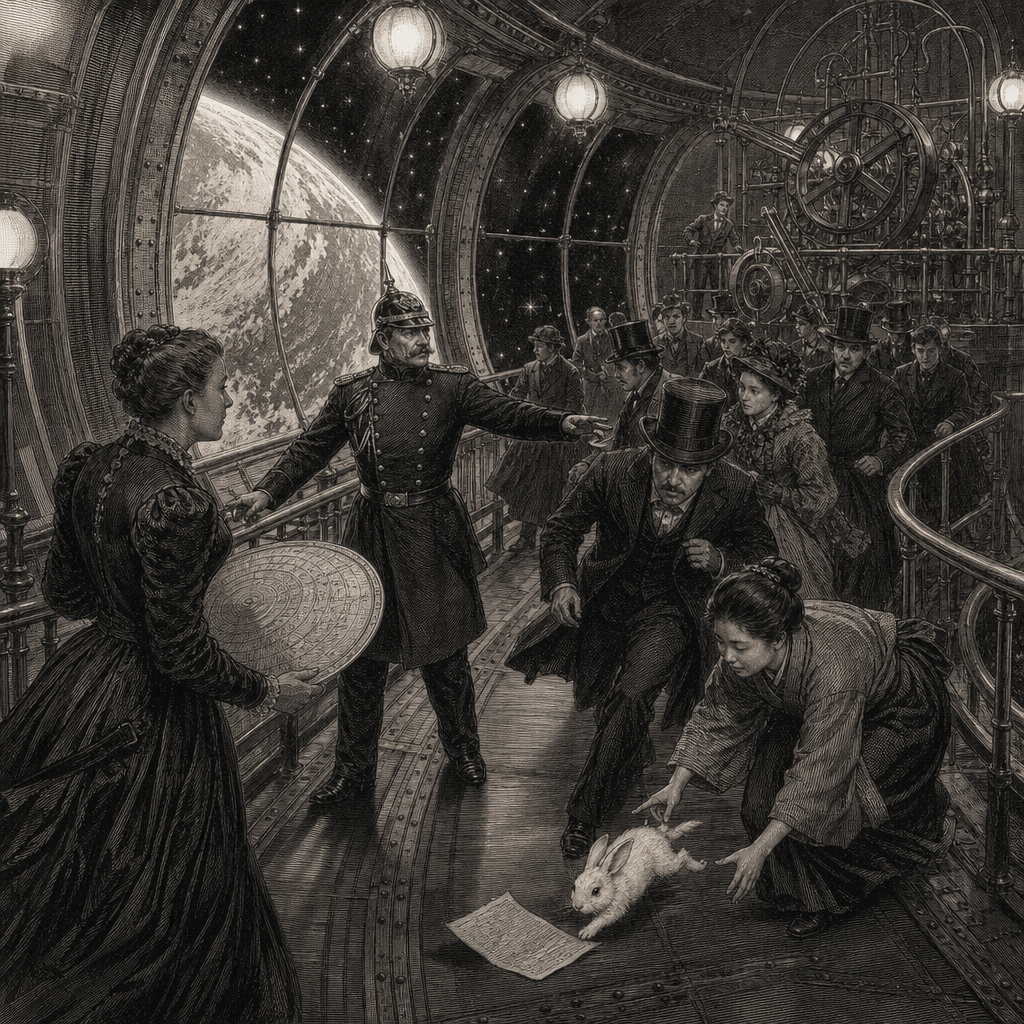
Dr. Lydia Fenner had just reached the portion of her lecture in which sensible men ceased to be sensible.
Behind her, the glazed promenade of the Asterion revolved with deliberate, expensive majesty: brass ribs, iron stanchions, electric globes burning white above the visitors’ hats, and beyond the curved windows the blue-and-white half-disc of Earth. The audience sat on folding chairs along the inner side of the ring. Ladies held programs. Boys pressed gloved fingers to the glass. A few gentlemen who had paid handsomely for the excursion stood at the rail with the expressions of men who expected history to entertain them.
Lydia held up an engraving.
It showed an imagined ether vessel of the 1840s: a circular gallery, its crew braced against an invisible wind, arrows curving around the circumference. The artist had crowded the deck with figures running toward one side, their coats streaming in a direction no ordinary breeze could explain.
“The doctrine,” Lydia said, “was that the luminiferous ether stood still, perfectly still, while worlds and ships moved through it. By 1859, it had become an embarrassment. By 1868, it is useful chiefly to historians, illustrators, and persons wishing to make a table of philosophers argue.”
A few people laughed.
Maki Tanabe, seated near the front in a dark travelling dress, raised her painted folding fan to hide a smile. Its silk showed rain bands, wind curls, and three tiny gold cranes beneath a cloud.
At the rear of the promenade, the calculating engine began to ring.
Asterion’s engine rang often: a neat bell for a completed table, a trim recommendation, a coal estimate. It did not ring during public lectures, and it did not usually continue after the operator had lifted the brass lever.
The bell rang seven times.
Then the card reader clattered.
A strip of punched paper crept from the slot. The young clerk beside it stared, then pulled it free.
“Captain,” he called in German.
Captain Ernst Volkmann came through the crowd from the outer passage. His uniform was dark blue, his beard trimmed squarely, his expression prepared to disapprove of whatever had interrupted the program.
The clerk handed him the sheet.
“Routine trim calculation,” Volkmann read. “Eclipse schedule.”
“That is expected,” said a gentleman near Lydia. “We enter shadow in twelve minutes.”
The captain folded the paper once.
“What is it?” Lydia asked.
He gave it to her.
The upper lines were ordinary enough: rotational rate, flywheel pressure, water reserve, estimated passenger mass. Then the numerals stopped.
In their place came names.
FENNER, LYDIA DR.
TANABE, MAKI
KRÜGER, ELSBETH
PIKE, SAMUEL
VOLKMANN, ERNST CAPT.
The names continued in columns, separated by small punched symbols like blackened compass points.
Elsbeth Krüger stood from her chair. A narrow woman in a grey travelling gown, severe collar fastened at her throat, she clutched her son’s cap as she searched the sheet for herself.
“Mein Name,” she said.
Then louder: “Das ist eine Sterbeliste.”
A death-list.
The word travelled faster than the paper.
“No one is to make such claims,” Volkmann said sharply.
But people leaned in. Those who found their names counted spaces between them, seeking age, rank, nationality, cabin, payment, health. Those who did not asked why.
The card reader clattered again.
A second sheet emerged, beginning with ballast figures and crossing them out in a dense overprint of names.
Maki rose without fuss. When Lydia offered her the first sheet, she looked from its columns to the promenade and then to the engraving.
The station gave a small shudder.
Every electric globe trembled in its cage. Earth darkened at one edge.
Eclipse had begun.
Samuel Pike arrived at a run from the maintenance hatch, sleeves rolled and face marked with grease.
“Captain,” he said in English, addressing Lydia as much as Volkmann, “outer shutters are binding in sectors five through eight. I’ve got two closed and three halfway. The rest won’t take their dogs.”
“Why?”
“Something’s loading the ring wrong. Flywheel governor’s hunting. Bearing pressure is up on the starboard side.”
The shudder returned, longer this time. A program slid from someone’s lap.
Volkmann took in the crowd, the darkening glass, the sheets of names, and Pike’s face.
“Alle Besucher in die Zentrallounge,” he ordered. “Immediately. Inner corridor. No luggage. Crew to the shutters.”
The crowd obeyed at first because there was an order to obey. Chairs scraped back. Families gathered themselves. The public party began flowing toward the inner corridor, where the curved floor rose gently away from the outer rail.
Then Elsbeth Krüger snatched a sheet from the clerk’s desk.
“My husband is not on it,” she cried. “My son is not on it. Why are we named?”
“Madam—”
“They are choosing us!”
A man pushed toward the corridor; another pushed behind him. Someone shouted that the central lounge had no windows. A child began to cry. The passage, intended for orderly tours of thirty, took the weight of a hundred frightened bodies.
The engine struck its bell again.
Pike glanced at it with open dislike. “If that contraption is tied to trim, it’s not calculating trim any longer.”
“It may be damaged,” Volkmann said.
“Then it’s damaged in a very literate manner.”
Lydia had spread the first sheet across the back of an empty chair and laid her engraving beside it.
Maki crouched opposite.
“This is not a register,” she said quietly.
Maki tapped the columns. “これは名簿じゃない。席順です。”
“A seating order,” Lydia said.
“Not seats exactly. Places. Look.”
The first column held Lydia, Maki, Pike, two broad-shouldered Belgian engineers, a porter carrying a baby, and an elderly woman whose fur cloak made her look twice her natural size. The next held lighter people, though not all light; children appeared among them, but never together. It was neither alphabetical nor by cabin number.
Maki pointed around the ring. “These black marks. They repeat.”
The symbols at the foot of each column were not printer’s ornaments. One was a vertical line with two short strokes to the right; another had them to the left. Crude clock positions.
Her eyes returned to the engraving.
The ether vessel’s circular deck was divided by just such marks. The old engraver had arranged arrows in radial sectors around the rim, showing where a crewman ought to stand if an ether-wind shifted his apparent weight.
The old lecture notes rearranged themselves in Lydia’s mind.
The theorists had imagined that motion through stationary ether could alter inertia by direction. A handcart pulled east might weigh differently from one pulled west. The notion had failed every useful test on Earth.
But Asterion was spinning, falling, entering eclipse, and passing toward the pale green disturbance at the edge of the black sky.
“Aurora,” Lydia said.
Pike looked through the darkening glass. “And it’s coming down our track.”
“In the old theory, electrical weather disturbed the ether.”
Pike gave her a look.
“I know how that sounds.”
“It sounds like you’ve chosen a bad moment to become a philosopher.”
The ring lurched.
A luggage cart beside the platform rolled not toward the outer rail, as it should have, but inward and slightly uphill. Its wheels squealed across the polished floor and struck a chair.
The crowd in the corridor screamed.
From below came the rising shriek of a flywheel.
Pike swore and ran for the hatch. “Bearing load’s moving! Captain, if we keep putting them all inside, we’re making it worse.”
Volkmann’s gaze moved from the cart to the packed corridor and the paper in Lydia’s hand.
“Explain.”
“The figures were for ballast correction,” Lydia said. “The engine has not lost its purpose. It has replaced fixed ballast with living mass because the load conditions have changed. These columns are sectors of the ring. The names are ranked by what correction their bodies can provide.”
“The engine knows the bodies of our visitors?”
“It knows the manifest. Age, ticket class, declared luggage, medical information. It has always used those for passenger loading.”
“And now it instructs me where to put people because an obsolete doctrine has revived itself?”
“It instructs you where their effective weight is wanted.”
Pike’s voice came back from the hatch. “Captain! Sector six is rising. I can feel it through the braces.”
Lydia pointed to the engraving. “The outer rim first. The old diagrams insist on it because a correction applied inward first throws the rim farther out of balance. The first column must go to the outer rail sectors. Then the next column inward.”
Volkmann read the sheet.
“You are in the first column.”
“Yes.”
“So is Pike. And Frau Tanabe.”
Maki folded her fan. “Good. I dislike being separated from the useful people.”
Pike barked a laugh from the hatch.
Volkmann did not smile. “If this is wrong, I direct civilians into a failing ring.”
“If it is right, sending them all to the lounge prevents the correction.”
A deep metallic knock sounded beneath the promenade. The floor tilted perhaps two degrees. Chairs slid. Men grabbed for the rail. In the corridor, the compacted crowd shifted inward with the instinct of people fleeing a moving wall.
Volkmann seized the speaking trumpet.
“Listen to me!” he shouted, first in German, then English. “No one is to proceed to the lounge. Return to the promenade. Follow the crew by columns. This is a trim operation, not an evacuation.”
“A death-list!” Elsbeth cried.
Volkmann rounded on her. “Nein. It is a load order. Your name is here because the station needs you alive and standing in a particular place.”
The certainty proved nothing, but it gave the frightened something stronger than rumour.
He thrust the sheet at Lydia. “You call the positions.”
She had commanded lecture halls, not human beings made suddenly into moving weights. Yet the black marks were brutally clear.
“First column,” she called. “Outer rail, sector five. Remain against the rail. Keep the passage clear.”
Pike emerged long enough to point. “That way. Clockwise to the red shutter lever. Stay there.”
“Second column: outer rail, sector six.”
Volkmann repeated each instruction in German. His crew took people by the shoulders, not roughly but firmly, dividing them at the crossings. Maki moved among the Japanese visitors who had gathered near the windows: two merchants, a young married pair, an elderly man with an asthmatic cough.
“こちらへ,” she said. “This way. Please walk, do not run.”
The first people reached the rail. The effect was not immediate, but the luggage cart stopped its uphill creep. The floor ceased increasing its tilt.
Then an overhead lamp burst.
The public flinched as one body. A few broke formation. Elsbeth clutched her son’s cap and tried to force her way toward the inner passage.
“Frau Krüger,” Lydia called.
Maki caught Elsbeth’s sleeve, said something soft in German, and pointed at the page. Elsbeth’s name lay in the third column.
“You are not being sent away,” Lydia said. “You are being placed with your husband’s section. Sector seven. Look—his name is here, under the next mark.”
There it was: KRÜGER, OTTO, in the fourth column. Not absent. Simply elsewhere in the calculation.
“My son?”
“Bring him. Third column, inner line.”
Elsbeth nodded and went where she was told.
The engine printed a third sheet. Several names had shifted.
“Changes,” Lydia said.
“Because they’re moving,” Pike shouted. “It’s updating the estimate.”
“Then no one changes place without instruction,” Volkmann said.
A small white shape shot from beneath a row of chairs.
For an absurd second Lydia took it for paper. Then Asterion’s rabbit bounded between ankles, ears flattened, tail flashing.
“Snowdrop!” cried a little girl in a blue coat, lunging after it.
She was a first-column child, already halfway to the rail. If she broke into the crossing passage, adults would turn after her.
Maki dropped her fan, bent with astonishing speed, and caught the rabbit against her chest before it vanished beneath the shutter lever.
Snowdrop kicked once and surrendered.
The girl stopped. Maki held out the rabbit with one arm and offered the other hand.
“Together,” she said.
The girl took it.
The movement held.
The Belgian engineers went to sector five’s outer rail, broad bodies braced beside the window. Pike, after arguing with a recalcitrant hatch, appeared again in the first column. Volkmann ordered another mechanic to the shutters and sent Pike to his assigned position.
“That is nonsense,” Pike protested.
“It is currently better mathematics than yours,” Lydia said.
He looked at the tilted floor, then the print, and went.
As he reached the outer rail, the flywheel’s scream dropped half a note.
Heads lifted. A woman who had been praying stopped. The artificial gravity did not return all at once, but the sense of sliding sideways eased, as if the station had found a more comfortable balance on its unseen axle.
“Fourth column inward,” Lydia called.
The symbols made a wheel on the page. She read from rim toward center, as the old engraving had shown crewmen moving in bands from the rail. Visitors stood shoulder to shoulder where they were ordered, clutching hats or one another, weeping or staring into the shuttered dark. The ring accepted them.
At the final crossing, a man refused to leave his wife in another sector.
Volkmann confronted him himself.
“You may stand with her when the station is not trying to turn us all into debris.”
The man went.
Asterion gave one last shiver.
Then the floor levelled.
The engine’s bell rang once.
Its final sheet contained no crossed-out figures, no new names. The columns remained fixed. At the bottom, where Lydia expected another sector mark, the machine had printed an ordinary figure: rotational rate, steady to three places.
No one cheered. People sagged against rails, sat where they stood, held one another with the embarrassed tenderness of strangers who had expected to die together.
Pike laid a greasy hand on the engine casing.
“It’s behaving.”
“For now,” Volkmann said.
He looked down the promenade: visitors arrayed in an order no host would have designed, lecture chairs overturned, paper strips trailing from the calculating engine.
Then he spoke quietly to Lydia.
“Public descent is cancelled.”
She understood he meant more than that evening’s descent to Earth.
“The board will suspend excursions,” he continued. “Until we know whether eclipse and auroral conditions can produce this again.”
“They should. The rules are consistent.”
“Consistent dangers remain dangers.”
Maki joined them, Snowdrop beneath one arm and her recovered fan beneath the other.
“I paid for a celebratory orbit,” she said. “Instead I became ballast.”
“You were excellent ballast,” Pike said.
Maki considered this. “In commerce, one accepts praise in the form offered.”
Much later, after the storm had passed and Pike’s crew had freed the shutters, one panel was opened under careful supervision.
Dawn entered the promenade: first a pale blade along Earth’s curve, then gold spilling over cloud tops. The visitors, still arranged in their improbable sectors, watched in silence. No one reclaimed the lecture chairs.
Lydia stood with Maki near the outer rail. Her engraving was creased almost through its centre. In its old black lines, imagined sailors leaned into arrows drawn by an artist who had believed in a universe no sensible physicist could accept.
Or had believed in it too soon.
Maki poured tea from a travel flask into two tin cups.
“To your lecture,” she said.
Lydia looked at the scattered sheets of names, the captain and mechanics at their instruments, the people who would return to Earth with a story unlike the advertised one.
“It was not much of a lecture.”
“No,” Maki said. “But everyone attended.”